


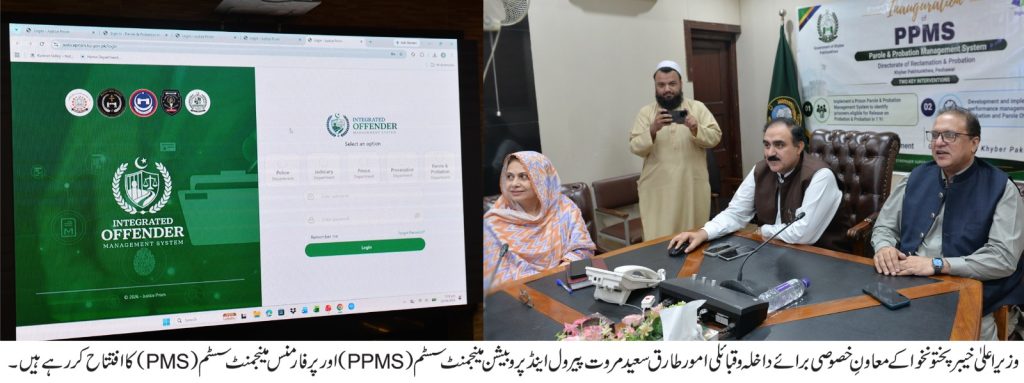
Special Assistant to the Chief Minister for Home & Tribal Affairs Tariq Saeed Marwat on Tuesday inaugurated the Parole and Probation Management System (PPMS) and Performance Management System (PMS) at the Conference Room of the Home & Tribal Affairs Department.
The ceremony was attended by Additional Chief Secretary Ikram Ullah Khan, Director Probation & Reclamation Farooq, Child Safety Representative Aftab, KP Information Technology Board representative Saad Javed, while Bashir, Shagufta and Gul Bano were also present.
Speaking on the occasion, Special Assistant Tariq Saeed Marwat said, “Under the Good Governance Roadmap of the Home & Tribal Affairs Department, we are committed to modernizing the parole and probation system through digital solutions. The launch of PPMS and PMS is an important step towards this objective.”
He said, “The Digital Parole and Probation Management System will provide a centralized platform for maintaining case records, prisoners’ details, court orders, release records and monitoring the progress of cases. This will make supervision and timely follow-up more effective.”
Tariq Saeed Marwat said the government was working to establish a transparent and systematic digital mechanism for identifying prisoners eligible for release on parole and probation, enabling timely access to relevant records and improving the decision-making process.
He further said, “The Performance Management System will provide a structured mechanism for monitoring the performance and service delivery of parole and probation officers. Data-based performance reviews will also help identify administrative gaps, workload requirements and training needs.”
The two systems have been developed by the Directorate of Reclamation and Probation under the Good Governance Roadmap of the Home & Tribal Affairs Department, with the support of Justice Prism, while the Khyber Pakhtunkhwa Information Technology Board (KPITB) has also provided technical support for the initiative.
The Parole and Probation Management System provides a centralized digital platform for entering case information, identifying records for eligibility assessment, monitoring case progress and ensuring timely follow-up. The system includes case-status tracking, alerts, reports, user management, assignment of responsibilities, prisoner details, court orders and release records.
The Performance Management System introduces a structured framework for monitoring the performance and service delivery of parole and probation officers. It will facilitate regular data-based monitoring, transparent performance assessment and identification of administrative requirements.
According to the system’s sample dashboard, the Parole and Probation Management System currently contains records of 12,163 prisoners, including 8,924 under-trial prisoners and 3,239 convicted prisoners. Similarly, the Performance Management System dashboard contains data on 450 active probationers, along with indicators relating to reports, reviews and approvals.
The Special Assistant said, “The purpose of these digital reforms is not merely to computerize records, but to strengthen transparency, accountability, effective monitoring and service delivery throughout the parole and probation system.”
He said reducing reliance on manual records would facilitate easier access to relevant information, strengthen the follow-up mechanism and support timely, organized and data-driven administrative decisions. The systems would also provide a foundation for future digital integration with the broader justice system.
The systems are currently in the testing and validation phase, during which identified issues and required improvements will be addressed with the support of KPITB. Training at the directorate level has already been completed, while further training of field formations is also planned to ensure effective implementation across the province.
Tariq Saeed Marwat said, “The provincial government is committed to institutional modernization and improved governance through better public service delivery. These digital reforms in the parole and probation sector will further strengthen transparency, performance, accountability and coordination within the system.”